So another prompt came from the Queensland Writers Centre-
Loaded Question
This just set off a free-flowing stream of ideas that culminated in the decision to explore abstraction further, I’ve been studying the idea of abstraction in art, in general, and especially in regard to short, short stories.
I listened to an audio book called ‘The Art of Brevity”.
How stories can be like flashes of feeling rather than a self-contained entity with the beginning, middle and end. Some may say (again) that this is an excuse to ignore form, but I don’t care. I’m here to explore, not to impress.
So I plugged in and let it out – And came up with another set of words encased in rainy wet weather.
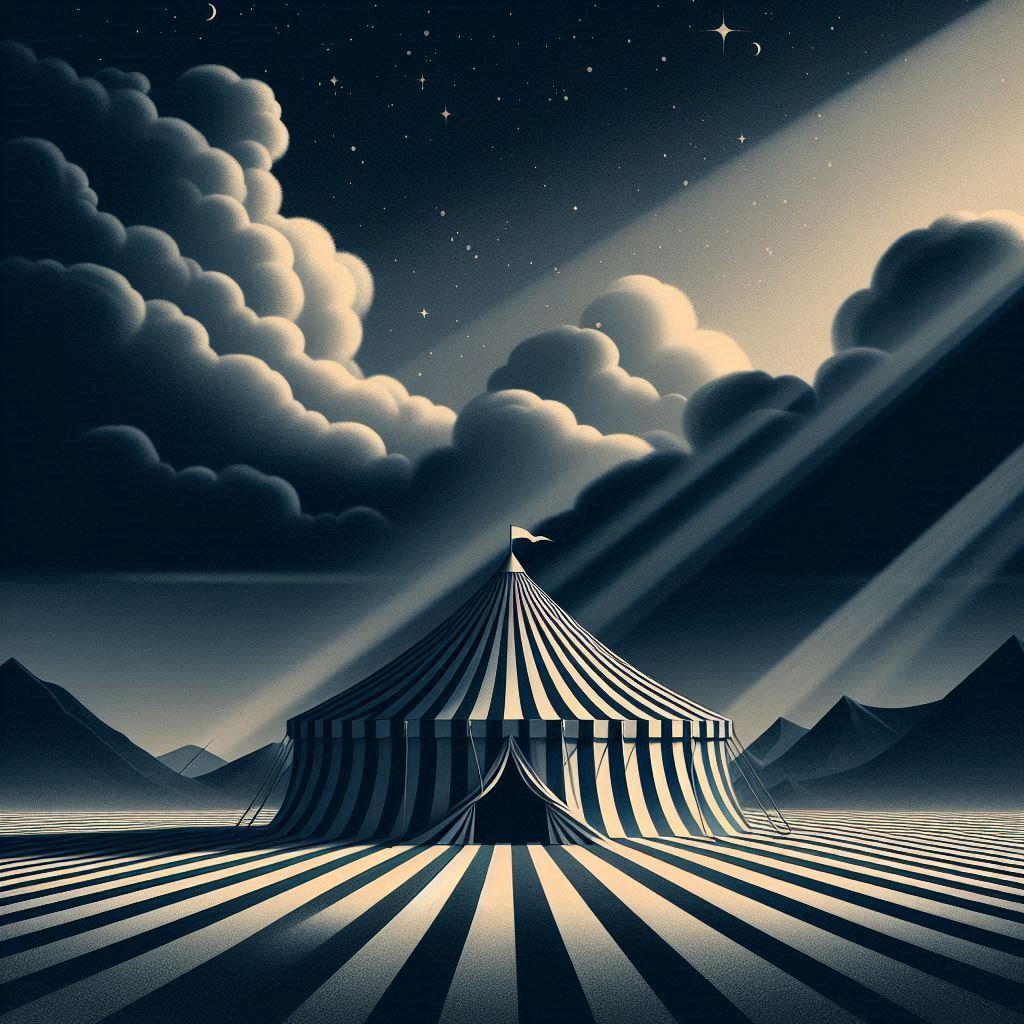
More story in rain. I’m wondering what all this wet weather is doing in here. Could just be an easy way to create an atmosphere of isolation. I’ve always loved rain winding on windows outside and the bright light you know is behind the dark clouds.
And this is falling back on the stalwart thought of show tents and performers and carnies and games of chance in travelling troupes.
If I could only be both a clown and a lighthouse keeper.
Solitude and Solicitation.
The Story
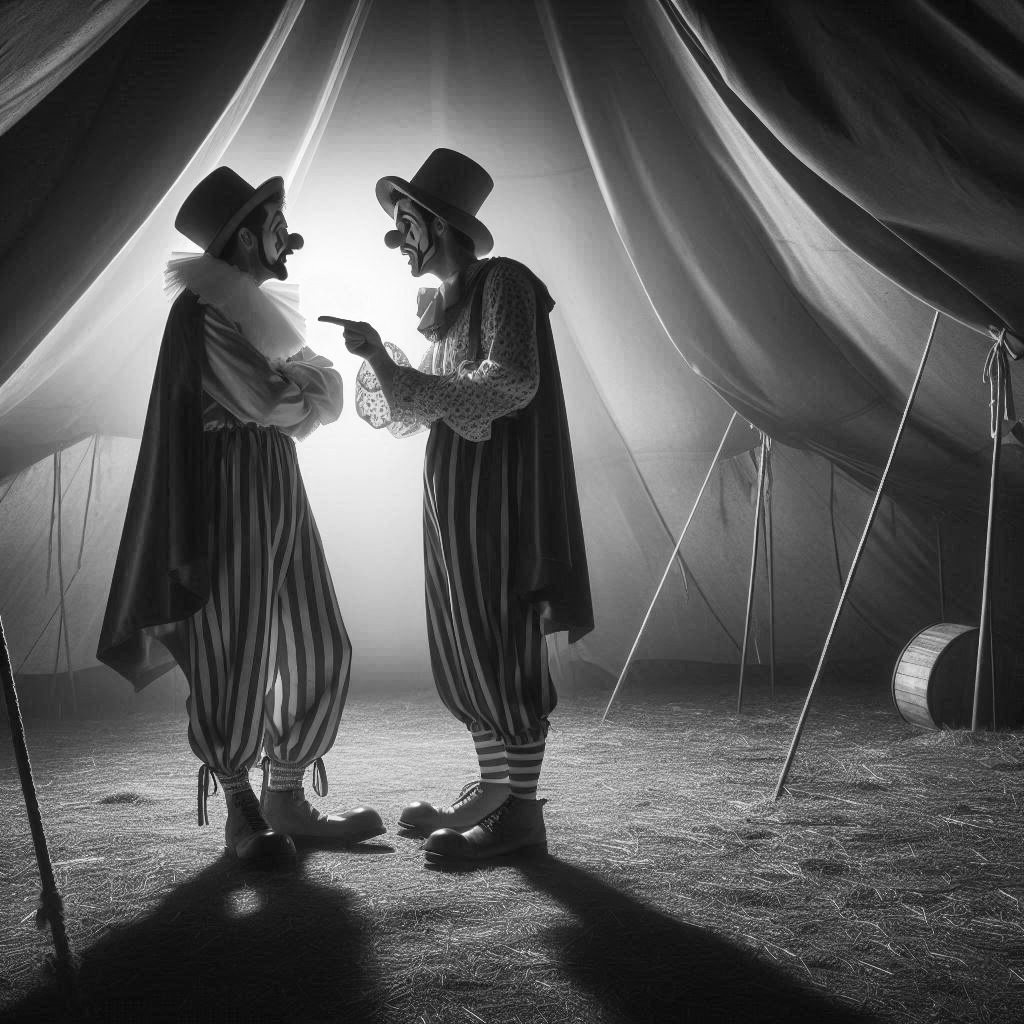
Two Clowns
Now that I’m gone it’s much easier to understand. Indeed it is only now possible for me to explain what happened from this new position of abstraction that now enables an explanation.
It all seems a pinprick of light in a sky of dark clouds at night. Condensed memories sifted and ordered, only available from this new position – the passing of life.
I’ve left the pain there, where it was made. Now someone else’s pain. I am outside the equation. I don’t possess the words, only the details. A burden not taken but realised.
Without form now, no vessel to control. No need to ponder. Released into oblivion adjacent in these words. And apart from love, that’s all that is left here now.
Can you see the lights above the clouds in the black sky?
It’s written from a posthumous perspective, which makes me think of authors like Pessoa and Kafka. I list of related titles came like little spaceships around their mother-
Out on a Limb
Stretching the Bow
Foray into the Fourth
Shadow People
Mirrors
But the next draft brought out a more narrative discourse, so I called it:
Two Clowns
Its quite long so you can read it here
Over the last two weeks I read a book by Alain de Botton
‘What you can learn from Marcel Proust’
Superbly researched and written, it painted a vista of an approach to seeing the creative act which I found inciteful. Of particular interest (apart from learning about “In Search of Lost Time” without having to read it), was a section on cliché. And that brings us to todays –
Cliche Origins
It comes from the French word cliché, which was originally a technical term in 19th-century printing. Printers used it to describe a stereotype block—a metal plate cast from movable type that allowed for repeated printing of the same text or image. The verb clicher meant “to click,” echoing the sound made when the mold struck the metal.
Because these plates reproduced the same thing over and over, the term cliché evolved metaphorically to describe phrases or ideas that are overused—like a verbal mold that’s been pressed too many times.
We lean on cliche as a way of navigating our world in a timely manner. We need to stop and explore the vistas of our experience to allow the vision to form through words, into something originally translated.
dodging cliché is like trying to walk a tightrope in a fog: the familiar phrases are comforting, but they blur the edge of originality.
Many phrases we now consider clichés were once his freshest inventions. Shakespeare minted expressions like:
- “Forever and a day”
- “Wild-goose chase”
- “Break the ice”
- “Wear one’s heart on one’s sleeve”
- “All that glitters is not gold”
These lines were dazzlingly original in his time, but through centuries of repetition, they’ve become an easy way to convey abstract meaning. They are shortcuts, the linguistic equivalents of well-worn paths through dense forest—they get us somewhere quickly. This is fine in general conversation, but in writing fiction they are just boring.
Cultivate the Sideways Gaze
Looking sideways means resisting the frontal assault of meaning. It’s about viewing from a different perspective to find the metaphor that hides behind the obvious.
Practice: Describe a familiar object (a spoon, a window, a shoe) without naming it. Let the description emerge from mood, memory, or myth. This trains the eye to see freshly.
Alain de Botton
In How Proust Can Change Your Life, he suggests that clichés are often truths that have been dulled by overuse, not falsities. The problem isn’t that they’re wrong—it’s that they’ve lost their capacity to move us.
He writes:
“The problem with clichés is not that they contain false ideas, but rather that they are superficial articulations of very good ones.”
he reframes cliché not as a failure of thought, but as a failure of attention. He argues that we need to re-see the truths behind clichés—to slow down, reflect, and allow those truths to regain their emotional force.
—he’s suggesting that cliché fails to capture the depth of who we are. That to truly express ourselves, we must sometimes break the rules of polite language, sidestep the expected, and invent new forms that match the contours of our inner life.
Conclusion
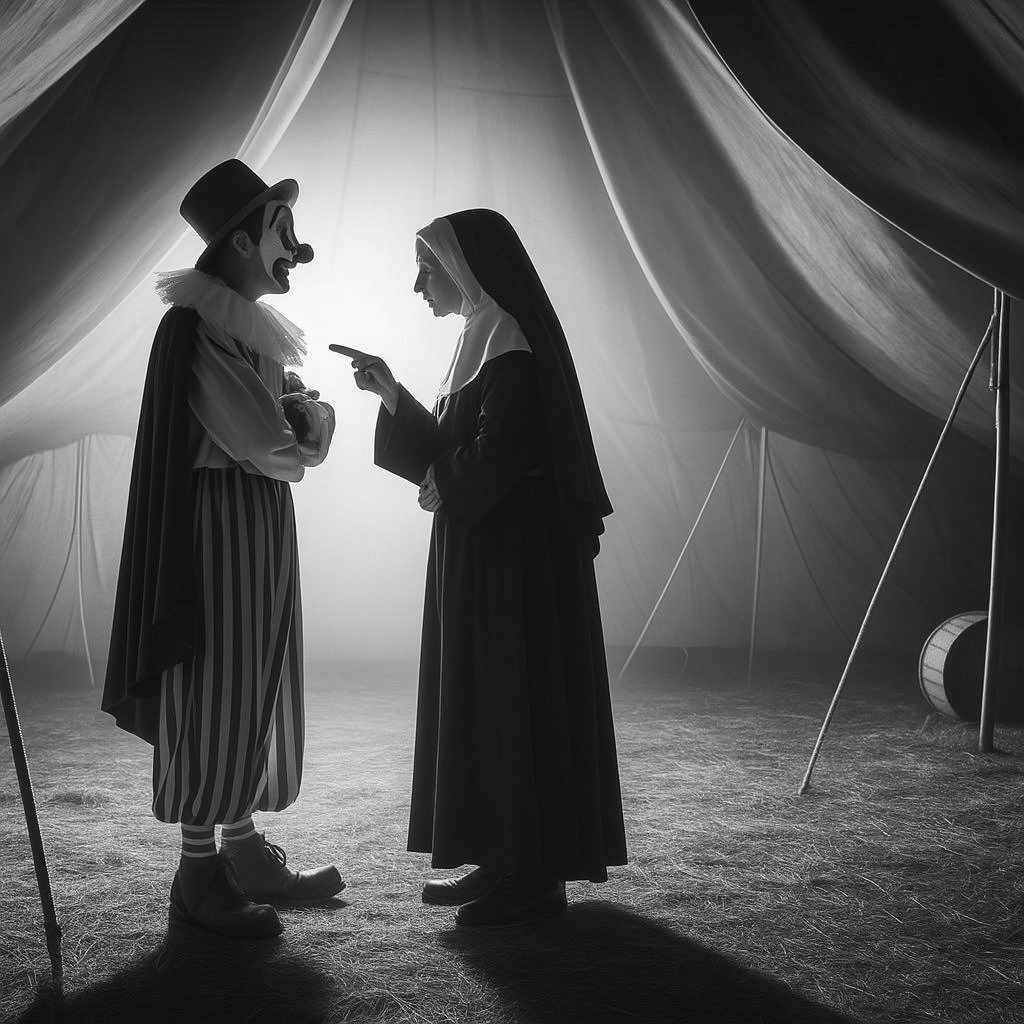
A workmate and I went off on a verbal tangent the other day and it went to a place where a nun was having a ‘conversation’ with clown. This imsge struck me as unususal and interesting and prompted me to change one of the characters – really changes the dynamic.
Instead of just calling it “Nun and Clown”, it needed to be morelike a question than a statement. There were two contenders:
Solitude and Solicitation (from the top of this blog) &
Veil and Vessel
So the whole story has come from being prompted by “loaded question” to becoming a loaded question.