Fossicking
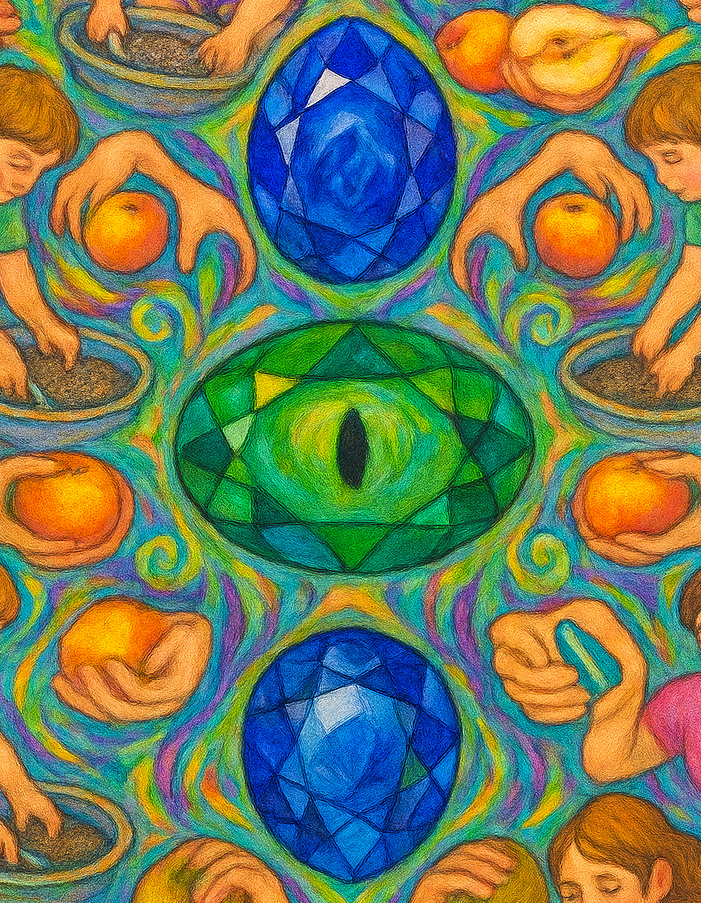
When I was about 14 years old, my Mum, my brother and I went on a holiday, fossicking for sapphires. We spent two days digging in the mud in craters, hauling the dirt up to the baths where we sieved it once, twice, and again, till we got to the silt that held the stones—
looking and trying and sweating and laughing and breaking for apples. Then, at the end, we had two small cobalt blue translucent stones, and a big green one with an eye in it. We went back to the hotel with our treasures and had some Paddle Pop ice blocks.
Finding Shiny Stones in the Mud
In Between the Cracks
So, I managed to knock out a rough draft of the idea.
I did this during morning tea and lunch at work yesterday, writing in a paper notebook.
I wrote during these times, but I was thinking of it whenever I could.
It wouldn’t leave me alone.
It Twisted
There was a satisfying moment while I was at work
when the ending appeared and kinda bookended the whole idea.
I suppose you could call it a twist.
I’ve used the names of the characters as the title
and don’t think I’ll use the names in the eventual story.
No need.
It’s 113 words too long, which is good.
Plenty of room to move.
Automatic Writing
Mainline
Automatic Writing is a technique where an individual writes down whatever comes to mind in an effort to allow the subconscious to rise to the surface.
This method is often used to tap into deeper layers of creativity and intuition.
By bypassing the conscious mind, automatic writing can reveal hidden thoughts, emotions, and ideas—
as a means of excavation.
This practice can help uncover inspiration that might not be accessible through deliberate thought.
It reminds me of ‘jamming’ music with a recording or with other people. You just let it happen and see where it takes you. When you find something that sits well you concentrate on that, using it to build a structure on which to hang words or whatever.
I ‘knocked it out’ using automatic writing- A mainline to the subconscious—
and the subconscious is where all the ideas are born,
live and die,
and are reborn.
Discovery - Mystical versus methodical
Uncovering things in the subconscious isn’t some kind of sorcery. Like most things that matter, it just takes time—and a bit of patience. You learn by doing, mostly. By letting yourself try.
Sometimes it helps to write without aiming for anything in particular. No reward, no outcome—just curiosity. Like a kid experimenting with how much plasticine fits in a hair dryer, not because it makes sense, but because it feels like something worth exploring.
It’s a practice. And when it starts to move on its own, it’s a lovely thing.
There are other ways in, too. Opening a book at random under a full moon, deliberately not thinking about elephants— that kind of magic has its place, though it’s a little slippery.
This way—this process—works for me. It’s often surprising. Sometimes joyful. Usually both.
Belief plays a part, too. It’s powerful stuff. If you believe something deeply enough, it can shape your experience in real ways. Not because it’s objectively true, but because it becomes true for you.
The Story
Heather and Rodney
Round and round and round; and round the other way.
“They make em now so they don’t last, on purpose, so ya have to get another one.”
Heather smiled again and nodded at the old man. He’s not a bad person, just very, very annoying. Talk the leg off a postman, whatever that means. It’s like he lives in the laundrette. Every time. She’s here every Friday, and so is he. She tried talking to him before but that train only travels one way- straight at you.
“It’s the way it is now, all about money, making a profit, the shareholders.”
He pronounced shareholders with all the hatred of the Old Testament.
“And I served in Vietnam for that. Bloody commies.” He looked at her and reached into his hessian bag. Out came the brandy.
“Don’t mind do you?” he asked. “Want some?”
She smiled and nodded again. He swigged, sniggered and shivered.
“Ah that’s better, now like I was saying love, if I had my time again there’d be no…”
Round and round, and round again. How many times. Every Friday night. I really got to get a bigger flat. One with a washing machine and a dryer. 10 minutes and the cycle would be done. At first she didn’t mind. There was something kinda romantic about a bum sipping brandy in a laundrette, but tonight he was really grating her bones, and he stank. Really stank. Sweet brandy and sweat.
“Yep they’ll take what little ya got then take a little bit more, suck the life outta ya, then chuck ya in a ditch. If things had worked out different hey.” He swigged again, and sniggered, and shivered, and offered it to her. She nodded no and smiled.
A midlife woman in a pale purple tracksuit with grubby ear pods came in, opened two of the larger dryers, pulled the warm clothes onto the long white table, lit a cigarette, and started folding, at breakneck speed, smoke in her mouth, mumbling.
This is too much tonight, I gotta get out of here. Got to escape. She got up, smiled and nodded, grabbed her handbag and walked to the door. Her machine beeped. Thank god. She put he bag down in front of the machine and pulled the wet clothes out in front of an empty dryer. Another 12 dollars, just to dry the damn clothes. She pulled her phone and swiped, started the cycle, and headed to the door.
“Finished love? I’ve had enough to, but I got nowhere to go. And the machines are warm, and they sing. They hum to me. My mum used to hum to me, but she don’t hum no more.”
She stopped and looked at him. His face was ruined, but it was smooth. Clean-shaven smooth. How could this wrinkly bum always have a face so smooth. Whatever I gotta go.
Glass broke and a tall man with a goatee strode in and pushed her against the machine, hard. His eyes shone a drugged sickness, fuming out through his psycho eyes.
“Give me what you got girl, where’s the money.” He grabbed her bag and she pulled it back to her hard.
“Bitch!” He stepped back, flicking a blade forward and towards her stomach. Crunch!
An arm pinched his neck from behind. The knife jolted to the floor, and the old man threw that asshole flat on the tiles. He rolled the man over and pinched him in a lock, nailed to the floor. With his knee in the dudes back and holding him still, he turned to Heather.
“You alright love?”
Heather nodded through the tears and the old man spoke.
“No-one hurts my friends, no-one.”
Reading in the Mirror
Reading this a couple days later,
I can see it is confusing in many ways.
It needs to be tightened up.
The different phases of the narrative need to be clearly separated
so that the whole is clearer.
I don’t particularly like how the old man talks.
He sounds a bit dumb,
and I don’t think he is.
Heather’s thoughts need to be composed differently.
The characters seem quite shallow at present.
I like the old man mentioning his mother.Maybe she could be a mother?
I’ll think about it when I can
and produce another draft over the next few days.

Short Stories Matter
The difference between flash fiction and a novel:
Most people I’ve worked with in the last twenty years in the metal work industry would not read a novel. They would probably read a 500-word story. That’s something.
Perspective and Perception
Zoom in and obsess – Zoom out and observe
Grasping the vastness of the solar system, let alone the universe, is beyond us. We navigate life within a narrow bandwidth of perception, knowledge, and lived experience. Our reality is filtered through a lens shaped by myth, memory, and cultural narrative. We overestimate our cosmic importance while underestimating our responsibility as stewards of this oasis. Not helpful to rely on magic as a solution to a real problem.
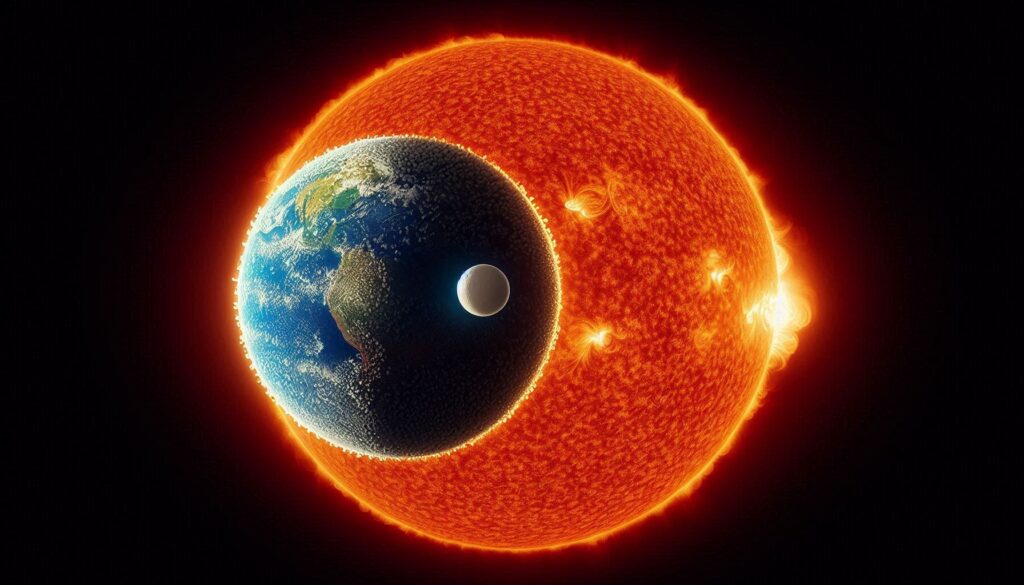
In art school I made a relative size model of the planets in our solar system in relation to the sun. To give you an idea:
Imagine the Earth is the size of a ping pong ball — about 3 cm wide.
- The Moon would be a marble, sitting about a meter away — like across the kitchen table.
- The Sun would be a giant ball about the size of your average T-Rex — about 3.3 meters round.
- But it wouldn’t be in the same room…
It would be 350 meters away.
Even though the Sun looks small in the sky, it’s huge and really far away.
That’s why it takes 8 minutes for sunlight to reach us — even though light is the fastest thing we can imagine!
But apart from this is the idea of perspective through experience – human perspective.
The idea of perspective through experience could be called experiential perspective, temporal empathy, or even narrative vantage. It’s the kind of insight that unfolds over time, shaped by memory, emotion, and lived context. Unlike spatial perspective, which is about where you stand in physical space, experiential perspective is about when and how you’ve stood—what you’ve felt, endured, and noticed along the way.