A Crack in the Moon
It’s eight days into the month and The Queensland Writers Centre hasn’t posted a new prompt for the Right Left Right Competition, so I’ve got one for myself;
Last night the moon was oblong like an egg on it’s side, and kind of looked like a brain in the late afternoon sky.
Egg Moon Brain
Not very imaginative I know but it’s something. I went to bed with that in mind, got up before everyone else, and wrote this in the torchlight:
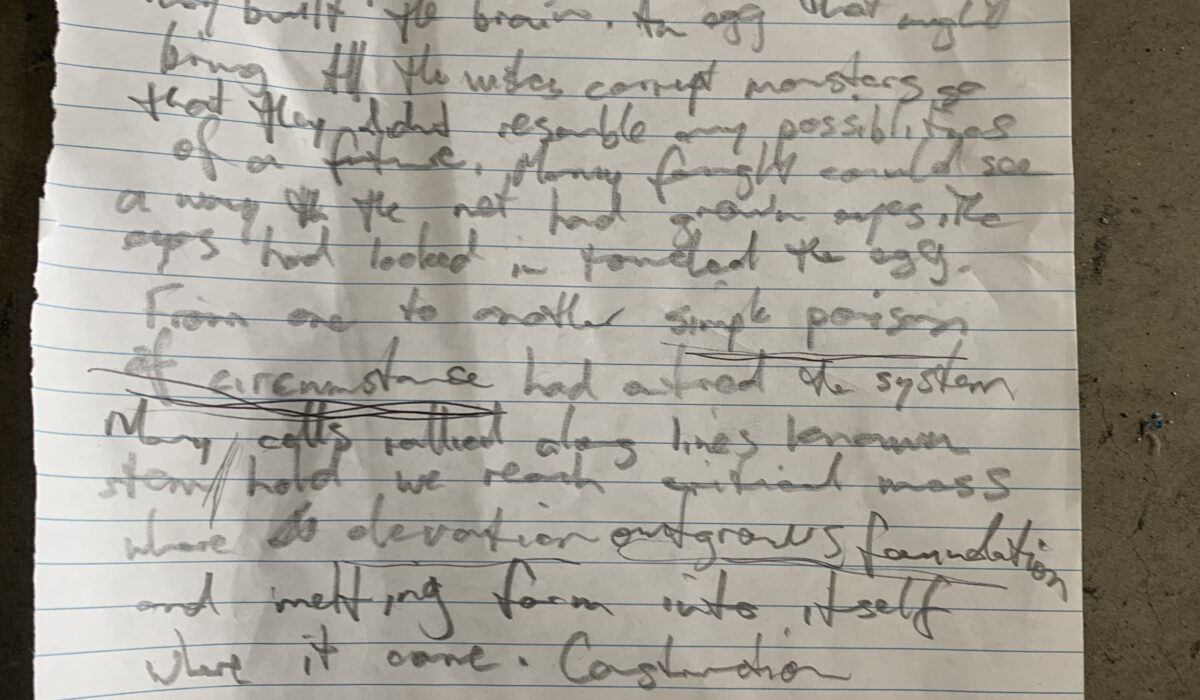
In amongst the barely legible mess was a poem which distilled during the morning at work.
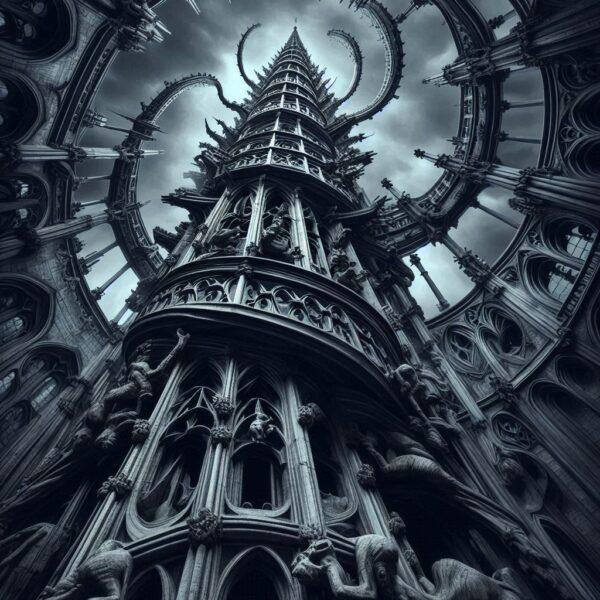
Twisted Towers
To this our city, the net looks in, with eyes outside the veil
The circumstantial poison flow, where height outgrows foundation
We navigate its dirty tides
Time, bent round or straight will drip, from the points of the Twisted Towers
Has a Neo-Goth dystopian feel to it. Reminds me of a song I wrote years ago about a “Gothic Twisted Tower” And has lyrical connections for me to ‘The Doors’, and visual triggers from ‘Blade Runner’ and ‘Terminator’ and a painterly feel of rain in a city in the morning. It’s not particularly interesting but it echoes another story premise I had bashing around inside so I glued it to that.
I think I should add here, (In a spirit of disclosure), that this whole thing was causing an undertow of anxiety, not that unusual but quite acute this time, but one must carry on, mustn’t one.
So armed with a few lines of words I drove to work listening to my current favourite interviewer, David Perell, talking to the award winning Jayne Anne Phillips. (Watch Here) This was inciteful and positivised the morning for me. uring the morning with the poem and glued together story bits in my head wrote this:
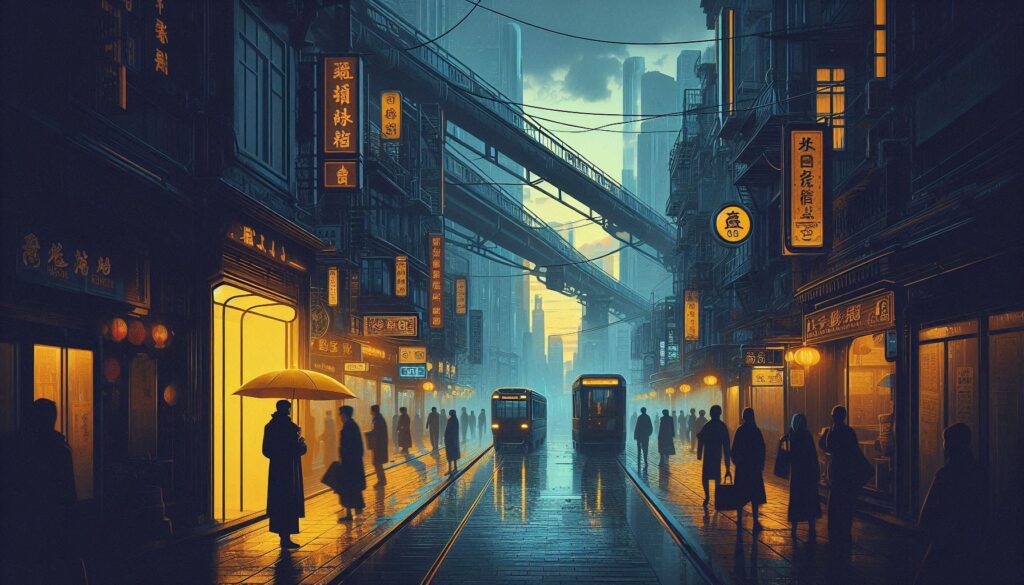
Light in the alcove beside the alley, like light can only be through the clouds and smoke and oil and amber tube lit from outside. Inside the amber tube the waiting is the worst. Worse than the pain.
The word clowns, dealing in feelings. The ink clubs harder to find. Wanting the feeling of having a future, the human feeling.
The com buzzes;
“You got it yet?… How long?”
He felt the same, painted into a corner
The Signal Bleeders
We’ll see how this evolves over the next few days of living. It brings with it an anxious feeling of wanting. I’m not sure what it means, if anything.
I’m following the feeling, not the words.
Two days later, in the morning and a longer version came up. It’s 5:21 on Sunday morning and I’ve set down a 444 word outline type description of the chased feeling.
It seems to be about wanting, needing something and not getting it. Sounds about right.
Makes me think of William S. Burroughs, a little of Hunter S. Thompson. It is definitely inspired by Katherine Mansfield (The Fly), and Virginia Woolf (The String Quartet). My new favourite short stories.
Loaded Question
So another prompt came from the Queensland Writers Centre-
‘Loaded Question’
This just set off a free-flowing stream of ideas that culminated in the decision to explore abstraction further, I’ve been studying the idea of abstraction in art, in general, and especially in regard to short, short stories.
How stories can be like flashes of feeling rather than a self-contained entity with the beginning, middle and end. Some may say (again) that this is an excuse to ignore form, but I don’t care. I’m here to explore, not to impress.

I’ve been listening to a good book about this called “The Art of Brevity”. It delves into the intricacies of the short short story, with great examples and insight.
So I plugged in and let it out – And came up with another set of words encased in rainy wet weather.
Here it is.
Two Clowns
Now that I’m gone it’s much easier to understand. Indeed, it is only now possible for me to explain what happened from this new position of abstraction that enables an explanation.
It all seems a pinprick of light in a sky of dark clouds at night. Condensed memories sifted and ordered, only available from this new position – the passing of life.
I’ve left the pain there, where it was made. Now someone else’s pain. I am outside the equation. I don’t possess the words, only the details. A burden not taken but realised.
Without form now, no vessel to control. No need to ponder. Released into oblivion adjacent in these words. And apart from love, that’s all that is left here now.
Can you see the lights above the clouds in the black sky?
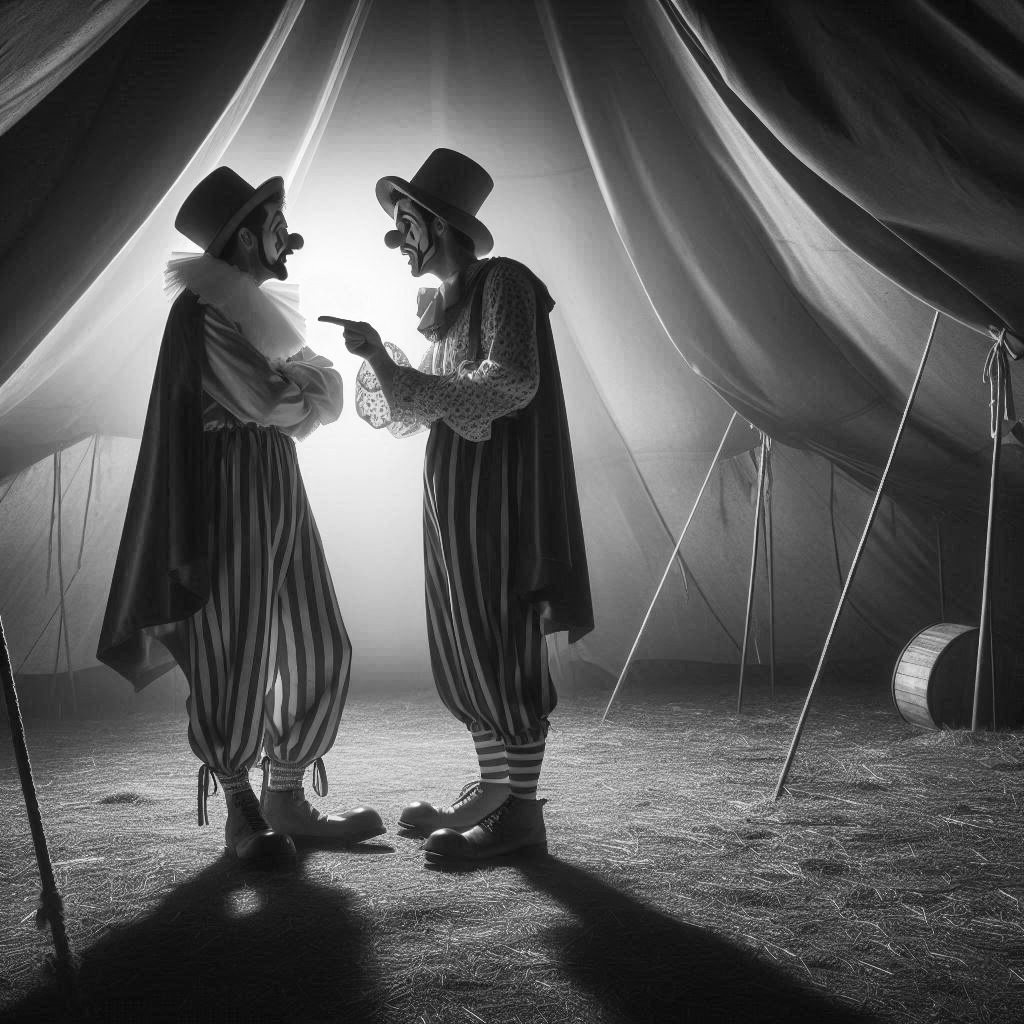
It’s written from a posthumous perspective, which makes me think of authors like Pessoa and Kafka. I list of related titles came like little spaceships around their mother-
Out on a Limb Stretching the Bow
Foray into the Fourth Shadow People
But the next draft brought out a more narrative discourse, so I called it:
Two Clowns
Its quite long so you can read it here
Cliché
Cliché is a comfortable scaffolding. They are the linguistic equivalents of well-worn paths through dense forest—they get us somewhere quickly, but you don’t smell the roses.
We lean on cliche as a way of navigating our world in a timely manner. We need to stop and explore the vistas of our experience to allow the vision to form through words, into something originally translated.
Dodging cliché is like trying to walk a tightrope in a fog: the familiar phrases are comforting, but they blur the edge of originality.
Origins
It comes from the French word cliché, which was originally a technical term in 19th-century printing. Printers used it to describe a stereotype block—a metal plate cast from movable type that allowed for repeated printing of the same text or image. The verb clicher meant “to click,” echoing the sound made when the mold struck the metal.
Because these plates reproduced the same thing over and over, the term cliché evolved metaphorically to describe phrases or ideas that are overused—like a verbal mold that’s been pressed too many times. This figurative usage first appeared in English around 1888, but it didn’t become common until the 1920s.
So when someone says “love conquers all” or “it was a dark and stormy night,” they’re echoing a linguistic stereotype—just like those old printing plates.
Alain de Botton
In How Proust Can Change Your Life, he suggests that clichés are often truths that have been dulled by overuse, not falsities. The problem isn’t that they’re wrong—it’s that they’ve lost their capacity to move us.
He writes:
“The problem with clichés is not that they contain false ideas, but rather that they are superficial articulations of very good ones.”
He reframes cliché not as a failure of thought, but as a failure of attention. He argues that we need to re-see the truths behind clichés—to slow down, reflect, and allow those truths to regain their emotional force.
—he’s suggesting that cliché fails to capture the depth of who we are. That to truly express ourselves, we must sometimes break the rules of polite language, sidestep the expected, and invent new forms that match the contours of our inner life.
End of Egg Moon Brain
This little adventure into the abstract world of dreams, colour, mood and time has been quite taxing on the constitution. It’s been fun , but I think it’s time to go somewhere more literal, with a regular, normal type timeline, somewhere ‘saner’.
I finished the two stories in this post and you can read them in the archive.
‘Two Clowns’ became became ‘The Clown and the Nun’, basically because it’s an interesting duo of characters that individually hold a load of metaphorical baggage, and together conspire to confuse in a way that freaks me right out.
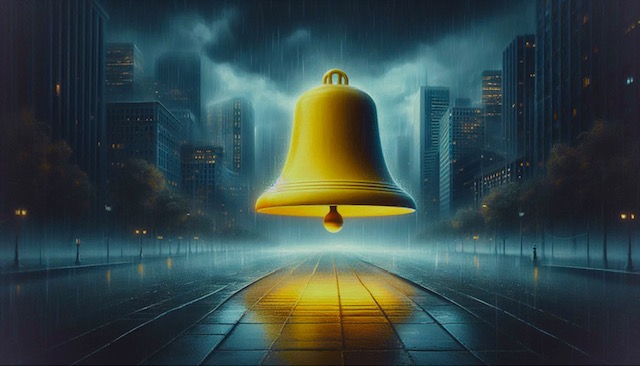
“Twisted Towers became “Yellow Bells” because its a great image. I could not drag this story out of the form of a poem so it remains, all grown-up, still more or less a poem.